


UV lasers at 355 nm cold-mark glass, plastic, ceramic and other heat-sensitive materials that a fiber laser would damage. From the air-cooled 5W entry to the 20W production tier, all on genuine JPT DPSS sources. Featured picks below, full range underneath.


About this category
A UV laser engraver is the right tool when you need to mark plastic, glass, ceramic, FR4, polymer film, or any heat-sensitive material that a fiber laser would damage. UV at 355 nm wavelength interacts with materials through cold-marking photochemistry rather than thermal ablation, so the heat-affected zone is essentially zero. Our UV laser engraver catalog covers 5W to 20W, all built around authentic JPT Opto-Electronics DPSS sources (Lark-355 and Seal-355 series).
Why UV laser marking machine over fiber laser
The wavelength does the work. Fiber lasers emit at 1064 nm in the near-infrared, where photon energy is absorbed thermally by the material surface. On metal this produces clean marks through thermal ablation. On plastic, glass, ceramic, and heat-sensitive materials, that thermal interaction melts, cracks, or chars the substrate. UV laser marking machines emit at 355 nm in the ultraviolet, where photon energy is high enough to break chemical bonds directly. The material absorbs the energy chemically (photoablation) rather than thermally, leaving no heat-affected zone around the marked area.
Practical result: a UV laser marking machine can mark perfume bottles without cracking the glass, polymer medical devices without affecting biocompatibility, PCB substrate without damaging copper traces, dental ceramics without cracking the surface. Fiber lasers cannot do any of these workloads cleanly. The trade-off is cost: UV sources are roughly 4 to 6 times the price of equivalent-power fiber sources because frequency-tripling Nd:YVO4 to 355 nm requires complex nonlinear-crystal optical chains.
UV laser marking machine power tiers
- 5W UV (Lark-355-5A): entry tier, air-cooled, no chiller maintenance. Small-batch glass, plastic, and ceramic marking. Most affordable UV machine in the catalog.
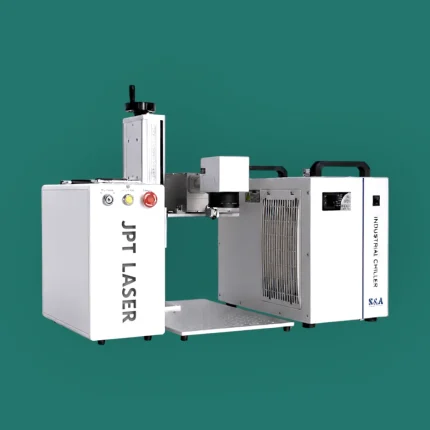
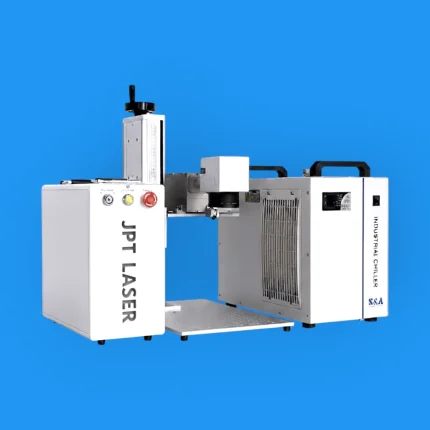
- 10W UV (Seal-355-10S): production entry tier with integrated 500W water chiller. Doubles 5W throughput. PCB and FR4 serialization, glass production marking.
- 15W UV (Seal-355-15S): production sweet spot. 1000W chiller, 50% more power than 10W. Industrial PCB lines, food packaging polymer film marking.
- 20W UV (Seal-355-20S): top UV power tier. Industrial volume production. Electronics manufacturers, medical device OEMs, high-volume glass packaging.
All four UV tiers share the same Sino-Galvo SG7110 scanning head, same beam quality M² less than 1.2 in TEM00 spatial mode, same 355 nm wavelength, and same 18-month warranty on UV source and machine. The differences across tiers are average power, pulse frequency range, and cooling architecture.
What a UV laser marking machine can mark
- Glass: perfume bottles, wine bottles, awards, decorative glass, lab glassware, crystal pieces. UV marks glass surfaces without thermal cracking at the bead edge that fiber lasers produce.
- Plastics and polymers: medical device housings, electronics enclosures, polymer connectors, automotive plastic components. Cold marking preserves substrate properties including biocompatibility.
- Ceramic: alumina ceramic substrates for electronics, dental ceramic components, decorative tile, industrial ceramic parts.
- FR4 and PCB: electronics substrate marking, component identification, traceability codes on epoxy-fiberglass laminates. UV does not damage thin copper traces.
- Polymer films: PET, polyethylene, polypropylene packaging films. Date codes and product identification on food packaging at line speed.
- Coatings and surfaces: anodized aluminum, painted surfaces where fiber laser would damage the coating, specialty coatings.
What’s included with every JPT UV laser marking machine
- 2 field lenses of your choice (70/110/175/210/300 mm)
- 1 rotary attachment (D60/D80/D100)
- Motorized Z-axis
- UV-rated safety glasses (355 nm), different from fiber laser glasses; do not mix them up in shops running both wavelengths
- Foot pedal
- EZCad 2 software on USB key
- Integrated water chiller (10W, 15W, 20W tiers; 5W is air-cooled)
- 18-month warranty on JPT UV source and machine
The 18-month UV warranty term reflects industry-standard UV diode service-life expectations. UV diode physics give them shorter rated lives than fiber sources (which carry 2 to 3 year warranties depending on tier). Our warranty matches realistic service expectations rather than overselling coverage. In practice, JPT UV sources frequently run 3 to 5 years before showing power degradation; the 18 months is the manufacturer-backed minimum.
DDP shipping on every UV laser marking machine
Every UV laser marking machine in our catalog ships DDP at no extra cost to US, Canada, and the EU 27. The listed price covers ocean and ground freight, customs clearance, and all import duties. Rest of world: free shipping, customs is the buyer’s responsibility at destination. See the shipping policy page for full freight terms. DDP transit is approximately 30 days by sea freight to US and Canada or 20 days by rail freight to EU 27, with customs and import duties included in the price. CIF air freight is available worldwide at 12 to 15 days transit if you prefer faster delivery and handle customs clearance yourself.
Frequently asked questions
What is a UV laser marking machine used for?
UV laser marking machines are used for marking materials that fiber lasers cannot handle cleanly: glass, plastic, ceramic, FR4 PCB substrate, polymer film, and other heat-sensitive surfaces. UV at 355 nm is the “cold marking” wavelength that does not produce a heat-affected zone.
How much does a UV laser marking machine cost compared to fiber?
UV laser marking machines are roughly 4 to 6 times the price of equivalent-power fiber lasers. The cost reflects the complex frequency-tripling optical chain (Nd:YVO4 1064 nm tripled to 355 nm through nonlinear crystals). Buy UV for application capability (non-metal materials), not for power per dollar.
Can a UV laser marking machine mark metal?
Yes but slowly. UV at 355 nm interacts with metal but the marking speed is significantly slower than a fiber laser at the same average power. For metal marking, use a fiber laser. UV is the right choice when the material is glass, plastic, ceramic, or heat-sensitive.
Why is the warranty only 18 months on a UV laser marking machine?
UV diode physics. UV diodes have shorter rated service lives than fiber sources. Our 18-month warranty matches realistic service expectations. In practice, JPT UV sources frequently run 3 to 5 years before showing power degradation; the 18 months is the manufacturer-backed minimum coverage period.
Do I need a separate water chiller for a UV laser marking machine?
No external chiller. The 10W, 15W, and 20W UV tiers ship with integrated, sealed water chillers (500W on 10W tier, 1000W on 15W and 20W tiers). The 5W UV is air-cooled and needs no chiller at all. No external plumbing required for any UV machine in our catalog.
Will a UV laser marking machine work on Tetra Pak-class polymer films?
Yes. UV is the industry-standard wavelength for polymer film marking on food packaging lines. The 10W and 15W UV tiers handle typical packaging film throughput; the 20W UV tier serves higher-volume production lines. PET, polyethylene, polypropylene all mark cleanly with UV at 355 nm.
≡ Open compare tool
→ Help me choose
✉ Email us


