
- You must select exactly 1 choice for Lens size.
- "Lens size" is a required field.
- "Rotary" is a required field.
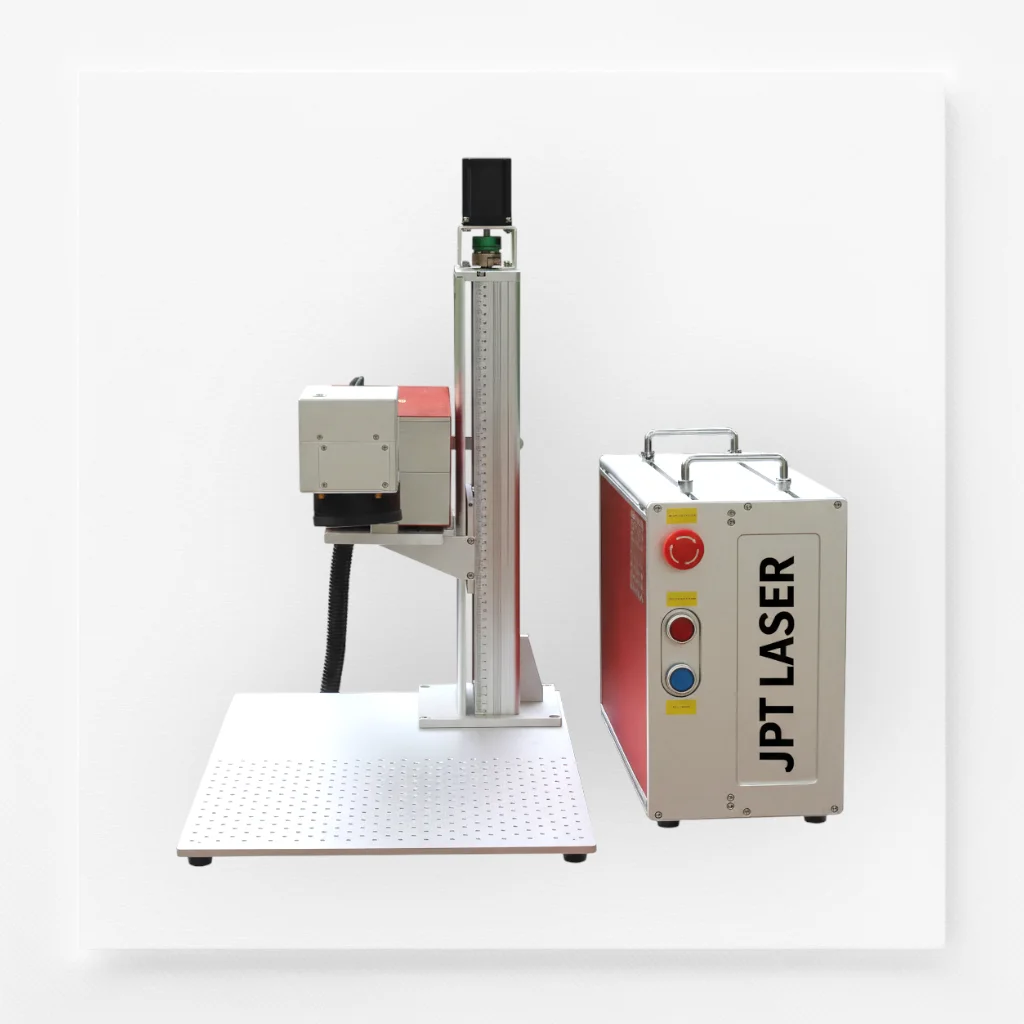
5W UV Laser Marker | JPT Lark-355-5A Air-Cooled Machine
$5,400.00
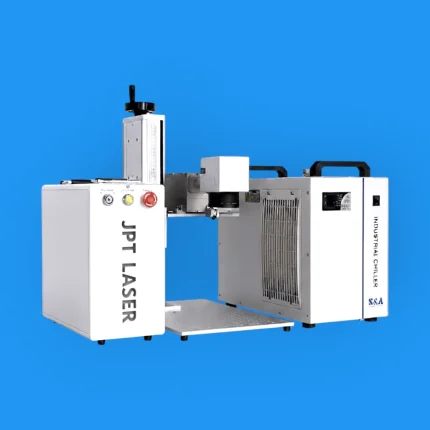
The Portable Cold Marker. 5W UV power with air cooling provides easy, zero-maintenance, damage-free marking on glass, crystal, and sensitive plastics. Perfect for benchtop use and high-end cosmetic packaging. Precision you can carry anywhere.
More views
Overview
The 5W UV Laser Marker is the entry tier of our UV catalog, built around the JPT Opto-Electronics Lark-355-5A source. This is a DPSS (diode-pumped solid-state) Q-switched nanosecond laser at 355 nm wavelength, not a fiber laser. The architecture is frequency-tripled Nd:YVO4, which is the standard way industrial UV lasers reach 355 nm. The key practical difference versus fiber: UV at 355 nm interacts with materials through cold-marking photochemical processes rather than thermal ablation, so the heat-affected zone is essentially zero. This is what makes UV the right tool for plastic, glass, ceramic, FR4, polymer films, and other heat-sensitive materials that a 1064 nm fiber laser would burn, melt, or crack.
Production buyers reach for the 5W UV laser marker when they need to add UV capability without major capital outlay. The 5W tier is the most affordable UV machine in our catalog and the only UV machine that ships air-cooled. Higher-power UV machines (10W, 15W, 20W) move to the JPT Seal-355 series with integrated water cooling. For shops doing small-batch glass marking, jewelry glass-setting marks, electronics PCB serialization on FR4, plastic component cold marking, and similar non-metal work, the 5W tier is the practical entry point. Production volumes above roughly 200 units per shift typically benefit from stepping up to 10W UV or higher.
What you get from JPT Laser Shop specifically: a verified JPT Lark-355-5A source with traceable serial number on the source ID plate, the Sino-Galvo SG7110 production-grade scanning head (the same scanner used on our 350W fiber laser flagship), DDP shipping with customs and duties paid by us for US, Canada, and EU buyers, plus an 18-month warranty on both UV source and machine. The 18-month UV warranty term reflects industry-standard UV diode lifetime expectations; UV diode physics give them shorter rated lives than fiber sources, and our warranty matches the realistic service life. We are an authorized JPT distributor so the Lark-355-5A in your machine is the genuine JPT source, with its model code on the source ID plate.
Technical specifications
Spec values below come directly from the JPT Lark-355-5A datasheet on en.jptoe.com. No interpolation, no estimation; every value is published by JPT for this exact model. If a parameter does not appear here, it is intentionally omitted to avoid invented facts.
Laser source, JPT Lark-355-5A
| Source model | JPT Opto-Electronics Lark-355-5A |
|---|---|
| Laser type | UV DPSS, Q-switched nanosecond (frequency-tripled Nd:YVO4) |
| Wavelength | 355 nm (UV) |
| Average output power | > 5 W at 50 kHz |
| Pulse width | < 20 ns at 50 kHz |
| Pulse frequency range | 20 to 200 kHz |
| Spatial mode | TEM00 |
| Beam quality M² | <= 1.2 |
| Beam diameter | 0.5 plus-minus 0.15 mm |
| Beam full divergence angle | < 2 mrad |
| Beam circularity | > 90% |
| Polarization ratio | > 100:1 |
| Polarization orientation | Horizontal |
| Average power stability (24h) | RMS <= 5% |
| Pulse-to-pulse stability | RMS <= 3% at 50 kHz |
| Cooling method | Air-cooled (unique among our UV catalog) |
| Supply DC voltage | 12 V |
| Maximum power consumption | < 200 W |
| Operating temperature | 0 to 40 °C |
| Storage temperature | -15 to 50 °C |
| Source net weight | 6.5 kg |
| Source dimensions (L×W×H) | 307.5 × 144.6 × 121.2 mm |
Galvo scanner, Sino-Galvo SG7110
| Scanner model | Sino-Galvo SG7110 (same as our fiber laser line) |
|---|---|
| Aperture | 10 mm |
| Scan angle | plus-minus 11 degrees |
| Marking speed | up to 6000 mm/s |
| Working area | 175 × 175 mm with 175 mm lens (70/110/210/300 mm lens options) |
Complete machine
| Power input | 110 to 240 V AC, 50/60 Hz (region cable at checkout) |
|---|---|
| Cooling | Air-cooled (no external chiller required) |
| Software included | EZCad 2 on USB key |
| Connectivity | USB, optional Ethernet |
| Warranty | 18 months on JPT UV source and machine |
What this machine can do
The 5W UV laser marker is designed for cold marking on non-metal and heat-sensitive materials where a 1064 nm fiber laser would damage the surface. Five canonical workloads at the 5W tier:
Plastic and polymer cold marking
Connector housings, electronics enclosures, polymer parts, ABS, polycarbonate, and similar plastics. The 355 nm UV wavelength produces high-contrast white or dark marks without melting the substrate, which fiber lasers (1064 nm) cannot do cleanly on most plastics.
Glass surface marking
Perfume bottles, awards, decorative glass, wine bottles. The cold-marking process leaves no heat-affected zone at the marked edge, so glass does not crack. The 5W tier handles small-batch glass marking; for higher production volumes step up to 10W or 15W water-cooled UV.
FR4 PCB and electronics serialization
PCB substrate marking, component identification, traceability codes on FR4 and similar epoxy-fiberglass laminates. UV is the industry-standard wavelength for electronics marking because it does not damage thin copper traces or substrate dielectric.
Ceramic and brittle material marking
Alumina ceramic substrates, dental ceramic, decorative tile. UV cold marks ceramics without the cracking that fiber laser heat causes on brittle materials. The 5W tier suits small-volume ceramic work; M8 fiber is the alternative for ceramics if production volume is higher.
Jewelry glass setting and decorative work
Marks on glass settings, crystal pendants, decorative glass elements in jewelry pieces. The compact air-cooled chassis fits typical jewelry workshop benches without dedicated cooling infrastructure.
What 5W UV is not for: metal marking (use a fiber laser for that, see our 20W M7 fiber laser), high-volume production above ~200 units per shift (step up to 10W UV or higher water-cooled tiers), deep engraving (UV is surface-marking by physics, not deep ablation), thick glass through-cutting (galvo geometry caps the cutting envelope regardless of UV power).
How this compares to adjacent models
| Specification | ★ This machine 5W UV (Lark-355-5A) |
10W UV (Seal-355-10S) | 20W UV (Seal-355-20S) | 20W M7 Fiber Laser |
|---|---|---|---|---|
| Best for | Entry UV, small batches | Mid-tier UV production | Higher-volume UV production | Metal marking (not glass/plastic) |
| Source model | JPT Lark-355-5A | JPT Seal-355-10S | JPT Seal-355-20S | JPT YDFLP-E-20-M7-S-R |
| Wavelength | 355 nm (UV) | 355 nm (UV) | 355 nm (UV) | 1064 nm (NIR) |
| Marking principle | Cold marking (photochemical) | Cold marking | Cold marking | Thermal ablation |
| Cooling | Air-cooled | Water-cooled (500 W chiller) | Water-cooled (1000 W chiller) | Air-cooled |
| Beam quality M² | <= 1.2 | <= 1.2 | <= 1.2 | < 1.4 |
| Plastic + glass + ceramic | Yes (entry tier) | Yes | Yes (production) | Limited |
| Metal marking | Slow (use fiber instead) | Slow | Slow | Yes (primary use) |
| Warranty | 18 months | 18 months | 18 months | 2 years (E-series fiber) |
Practical guidance: choose 5W UV when your work is small-batch non-metal marking and you want to avoid the chiller maintenance overhead of higher UV tiers. Step up to 10W UV when production volume requires faster cycle times or when you need the higher pulse energy that 10W delivers. Pick the 20W M7 fiber laser instead if your primary work is metal marking; UV is overkill (and slower) for metal compared to fiber. See the full laser comparison tool for a side-by-side spec walkthrough.
What’s in the box
- 2 fused-silica (quartz) field lenses of your choice from 70 mm, 110 mm, 175 mm, 210 mm, or 300 mm
- 1 rotary attachment of your choice: D60, D80, or D100
- Motorized Z-axis for focus on stepped parts
- UV-rated safety glasses (355 nm wavelength rated, different from 1064 nm fiber glasses)
- Foot pedal
- Marking head with selected lens fitted
- USB cable, region power cable
- EZCad 2 software USB key
- Quick-start guide, cleaning kit, spare lens wipes
- 18-month warranty registration card
The UV-rated safety glasses are specifically important. UV at 355 nm is more hazardous to eyes than the 1064 nm wavelength used by fiber lasers, so the safety glasses included with the UV machine are different from fiber laser glasses. Do not mix them up if your shop runs both UV and fiber lasers; each wavelength needs its own dedicated eye protection.
Software and upgrade options
This UV machine ships with the standard Sino-Galvo SG7110 galvo head and EZCad 2 software included on USB. Unlike the fiber catalog, the UV catalog does not offer an intermediate 2.5D upgrade; UV applications either work on flat surfaces (the standard head is sufficient) or require full 3D dynamic focus (Feeltek upgrade below).
Base configuration: SG7110 head + EZCad 2 + LightBurn via adapter
The standard configuration handles all flat-surface UV marking. EZCad 2 is the UV control software and has dot-matrix raster and photo-engraving modes well suited to UV-sensitive materials. LightBurn is supported via a USB adapter for operators who prefer that workflow.
3D upgrade: Feeltek FR10-U dynamic-focus head + LenMark (USD 5,500)
The FR10-U steers focus in software (LenMark) and uses no swappable field lens — up to a 600 × 600 mm field.
This upgrade replaces the standard SG7110 with the Feeltek FR10-U 3D dynamic-focus head. This is the UV-specific Feeltek model with optical coatings and beam-path tuning for the 355 nm wavelength. The upgrade adds LenMark software (Feeltek’s controller-side 3D mapping software). What you gain: continuous focal-length adjustment as the galvo mirrors point the UV beam across a curved or three-dimensional workpiece. UV is the right wavelength for marking glass, ceramic, clear plastics, silicone, and coated metals; the 3D head extends that capability to round, domed, or contoured versions of those workpieces.
When to choose the 3D upgrade: production volume on curved workpieces in UV-suited materials. Perfume bottles, cosmetic packaging, wine bottle accents, watch case-backs in ceramic, pharmaceutical vials, glassware for hospitality and luxury brands. If you are running batches of dozens to thousands of curved UV-suitable parts per shift, the 3D head dramatically cuts cycle time versus repositioning the workpiece between focal heights. For one-off curved jobs the standard fixed-focus head still works but is much slower per piece.
Our 3D UV engraving guide walks through the complete workflow from CAD model to engraved curved part using the Feeltek and LenMark pipeline.
Marking area by lens
The included lens choice determines the marking area on the workpiece. Every JPT UV machine ships with two lenses of your choice from the standard set; the 175 mm lens is included by default unless you specify otherwise at checkout.
| Lens focal length | Marking area | Best for |
|---|---|---|
| 70 mm | 70 x 70 mm | Small parts: micro-text on electronics, fine-detail glass marking |
| 110 mm | 110 x 110 mm | Medium UV work: small bottles, PCB boards, electronic enclosures |
| 175 mm (default) | 175 x 175 mm | General UV production: cosmetic packaging, mid-size glass and plastic parts |
| 210 mm | 210 x 210 mm | Larger UV parts: wine bottle accents, larger ceramic panels |
| 300 mm | 300 x 300 mm | Maximum area: full-field UV marking on large flat parts |
Configuration and capability summary
| Configuration | Head | Software | Use case |
|---|---|---|---|
| Base (standard) | Sino-Galvo SG7110 | EZCad 2 (USB), LightBurn (via adapter) | Flat UV marking on glass, ceramic, plastics, coated metals |
| 3D upgrade (USD 5,500) | Feeltek FR10-U | LenMark (Feeltek) | Curved or 3D UV workpieces in production volume |
The 3D upgrade is installed at the factory at the time of order. Adding it later requires shipping the head back as a service exchange. If you know at purchase that your UV work will include curved workpieces in production volume, configure the upgrade at checkout.
Shipping and delivery
Lead time: 3 to 4 weeks from order confirmation. UV sources have lower JPT factory production volume than fiber sources, which extends factory build time slightly.
Shipping: Free DDP delivery to USA, Canada, and the EU 27 with all customs and import fees included in the listed price. Free shipping for rest of world; buyer handles customs through their broker at destination. The 5W UV crate is moderate (approximately 28 to 32 kg shipping weight) which keeps freight cost manageable. DDP transit is approximately 30 days by sea freight to US and Canada or 20 days by rail freight to EU 27, with customs and import duties included in the price. CIF air freight is available worldwide at 12 to 15 days transit if you prefer faster delivery and handle customs clearance yourself.
Crate: standard curbside delivery. The 5W UV is the lightest UV machine in our catalog so most shops receive it without lift-gate or loading-dock requirements. Full freight contract terms are on the shipping policy page.
Warranty
The 5W UV laser marker includes an 18-month warranty on both the JPT UV source and the machine. The 18-month term reflects industry-standard UV diode service-life expectations. UV diode physics produce shorter rated lives than fiber laser sources (which carry 2 to 3 year warranties depending on tier), and our warranty matches the realistic service life rather than overselling coverage we cannot economically support. The warranty covers manufacturer defects, UV source failure not caused by misuse, and the machine’s control electronics and assembly.
Returns are accepted only for defective equipment confirmed by our engineering team within 30 days of delivery. Industrial laser machines are made to order; defective machines are returned at our cost via the original crate. Full text on the returns and warranty page.
Frequently asked questions
Why is 5W UV more expensive than 30W or 50W fiber lasers?
UV diode physics. UV at 355 nm requires frequency-tripling a 1064 nm Nd:YVO4 laser through nonlinear crystals, which is a substantially more complex optical chain than direct 1064 nm fiber emission. The crystal cost, the pump diode cost, and the lower production volume all combine to make UV sources roughly 4-6x the price of equivalent-power fiber sources. The reason to buy UV is application capability (plastic, glass, ceramic) that fiber cannot do, not power per dollar.
Can a 5W UV laser mark metal too?
Technically yes, slowly. UV at 355 nm interacts with metal but the marking speed is significantly slower than a fiber laser of equivalent average power because the wavelength is not optimized for metal ablation. If metal marking is the primary work, a 20W or 30W fiber laser is the right tool and far more cost-effective. UV is the right choice when you need plastic, glass, ceramic, or heat-sensitive material capability that fiber cannot deliver.
Is the 5W UV really air-cooled when higher UV tiers are water-cooled?
Yes. JPT specifies the Lark-355-5A as air-cooled because the average power is low enough that the source can dissipate heat without forced liquid cooling. The 10W, 15W, and 20W UV tiers move to JPT’s Seal-355 series which uses integrated water chillers because the higher power density needs forced cooling. The 5W UV is the only UV machine in our catalog without chiller maintenance overhead, which is one of its main practical advantages for small shops.
What is “cold marking” exactly?
Cold marking refers to UV laser interaction that produces a visible mark on the material surface without significant thermal energy transfer to the surrounding area. At 355 nm, the photon energy is high enough to break chemical bonds directly (photochemical interaction) rather than relying on thermal absorption (photothermal interaction, which is how fiber lasers at 1064 nm work). The result: marks on plastic, glass, ceramic, and similar materials with essentially zero heat-affected zone. The substrate does not melt, crack, char, or warp.
Will the 5W UV last more than 18 months?
Usually yes, often substantially longer. The 18-month warranty is the manufacturer-backed minimum service life. In practice, JPT UV sources frequently run 3 to 5 years with regular use before showing power degradation. The warranty term reflects what we can economically guarantee, not the typical service life. UV sources do degrade more gradually than fiber sources, and end-of-life is usually a slow power decline rather than sudden failure.
How long until I receive the 5W UV laser marker?
About 5 to 7 weeks from order to delivery. Factory production lead time is 3 to 4 weeks (UV source production volume is lower than fiber); DDP transit is approximately 30 days by sea freight to US and Canada or 20 days by rail freight to EU 27, with customs and import duties included in the price. CIF air freight is available worldwide at 12 to 15 days transit if you prefer faster delivery and handle customs clearance yourself.
Are import duties really included for international buyers?
For US, Canada, and EU 27 buyers, yes. We ship DDP (Delivered Duty Paid), which means the listed price covers ocean and ground freight, customs clearance, and all import duties at entry. We handle US Customs and Border Protection, Canadian Border Services Agency, or the relevant EU member state customs authority. Outside DDP zones: free shipping but customs is the buyer’s responsibility at destination port.
How do I know this is a genuine JPT source?
Real JPT. The Lark-355-5A model code is on the source ID plate, verifiable directly with JPT Opto-Electronics. We are an authorized JPT distributor; the authorization documentation is on our authorized distributor page. We publish the exact model code, and it is on the source plate, so you can verify the genuine JPT source directly.
Production deployment notes
The 5W UV laser marker is popular with shops adding UV capability for the first time. Typical buyers: small electronics labs doing PCB serialization, jewelry workshops adding glass-setting marking capability, gift and award producers doing decorative glass, packaging prototype labs doing plastic component identification, dental ceramic labs needing UV for ceramic substrate work. We do not publish a specific named customer reference for the 5W UV tier yet; named customer stories tend to settle on higher-power UV tiers where production volumes justify the case study. If you want to talk to a current 5W UV operator about workflow before ordering, email us and we will coordinate a reference call where the existing customer has given permission.
You may also consider
1 review for 5W UV Laser Marker | JPT Lark-355-5A Air-Cooled Machine
What it can mark
Sample marks shown are representative of this machine class. Ask an engineer for a free test mark on your own material.



Kenneth Blaine –
The level of professionalism, quality, and respect I’ve gotten from JPT Laser employees has been admirable. I will continue to brag about my 5W UV laser to everyone I meet.