
- You must select exactly 2 choices for Lens size.
- "Lens size" is a required field.
- "Rotary" is a required field.
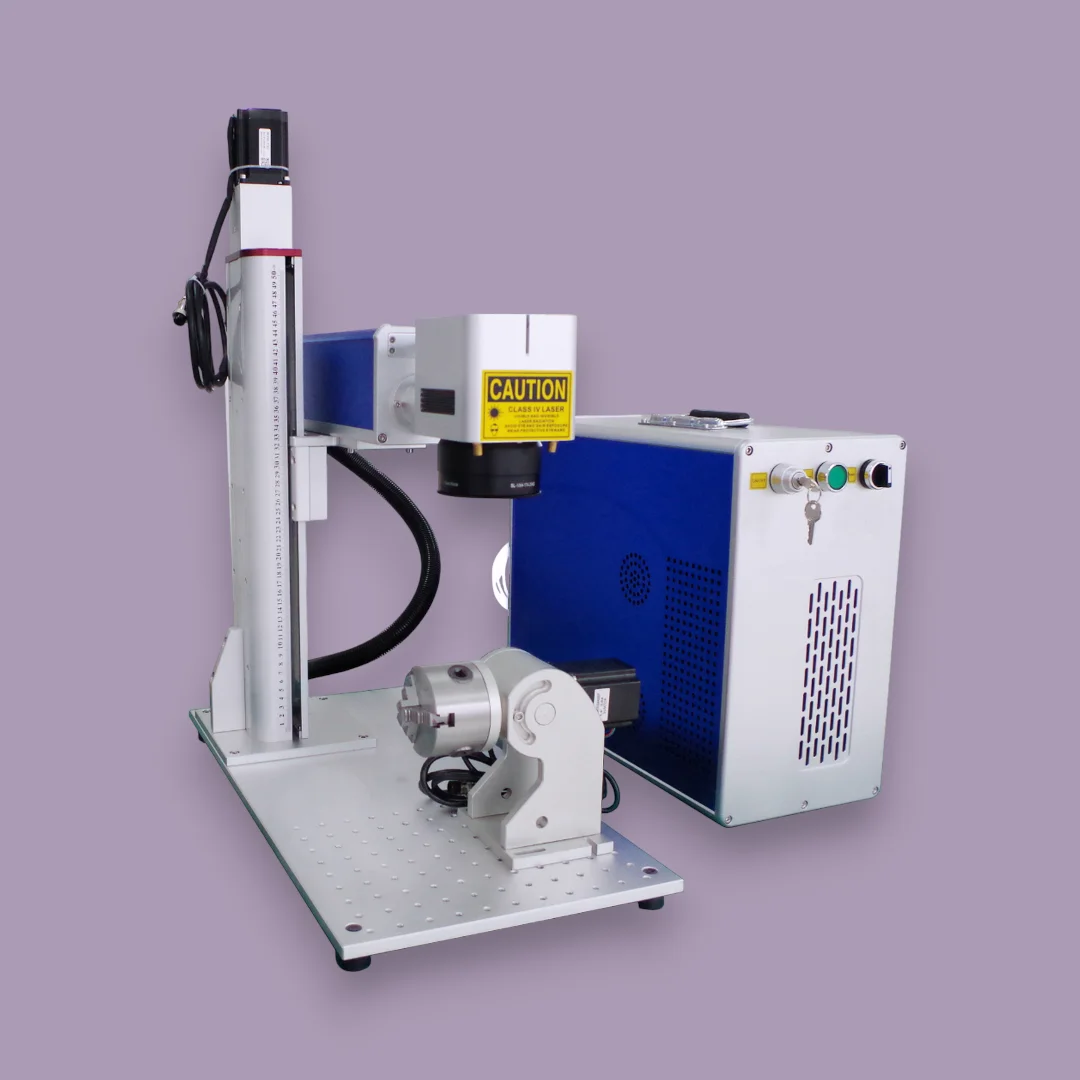
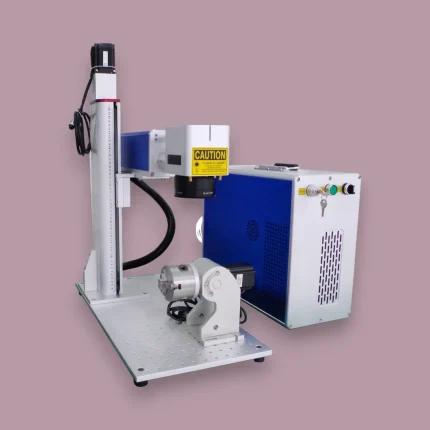
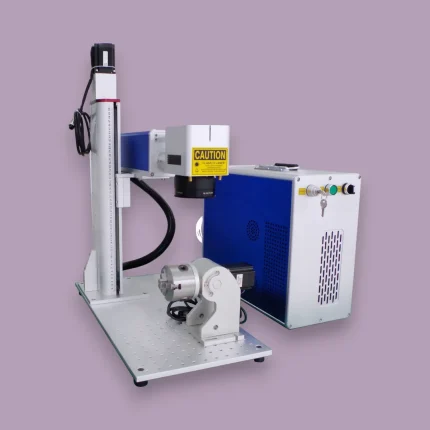
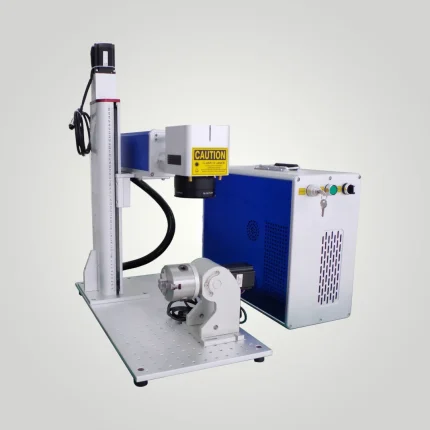
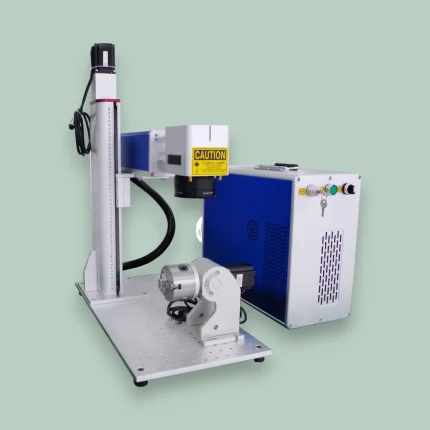
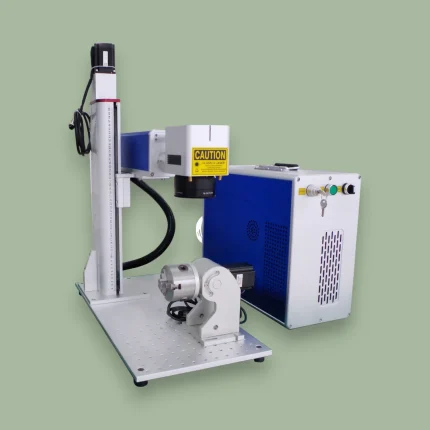
20W M8 Fiber Laser Machine
$3,300.00
Aesthetic & Detail Master. 20W M8 MOPA for surgical precision, full-color stainless steel marking, and zero-damage black anodization. Best-in-class control for jewelry and electronics. Perfect quality guaranteed.
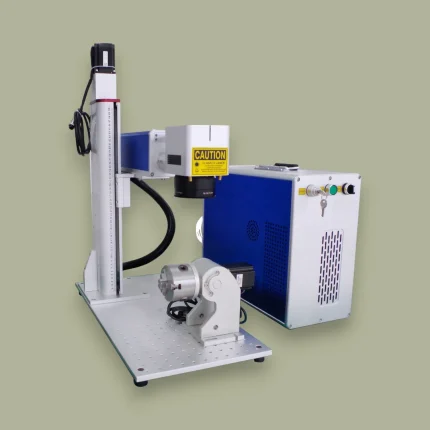
More views
Overview
The 20W M8 Fiber Laser is the entry point to JPT’s M8 short-pulse architecture, built around the YDFLP-20-M8-M-R source. Two things make this machine unusual compared to every other galvo in our catalog. First, it accepts AC mains input directly (100 to 220 V AC), not the 24 V or 48 V DC supplies that other M7 and higher-power M8 sources require. Second, it has the smallest source chassis we sell: 2.7 kg in a 105 × 272 × 76 mm body, smaller than even our compact 20W M7.
The M8 architecture matters when your work involves materials where M7’s longer pulse range produces too wide a heat-affected zone. Glass and ceramic marking, alumina ceramic precision marking, brittle material processing, and thin-foil work are the canonical entry M8 use cases (glass drilling is a 120W-and-up M8 capability). At the 20W tier, the M8 is sized for small-lot prototyping and SMB ceramic or glass work, not for production volumes (step up to 50W M8 or 120W M8 for production).
What you get from JPT Laser Shop: a real JPT M8 source (YDFLP-20-M8-M-R, on the source ID plate), the Sino-Galvo SG7110 scanning head, DDP shipping with customs and duties paid for US, Canada, and EU buyers, and the 3-year warranty on both M8 source and machine. The 20W M8 is the cheapest path into M8 architecture; smaller and lighter than the 100W M8 which is JPT’s other M8 model with a published datasheet.
Technical specifications
Laser source, JPT YDFLP-20-M8-M-R
| Source model | JPT YDFLP-20-M8-M-R (real M8) |
|---|---|
| Architecture | MOPA, M8 series (short-pulse) |
| Average output power | > 20 W |
| Wavelength | 1064 nm |
| Pulse width range | 2 to 500 ns (M8 family standard) |
| Pulse frequency range | 1 to 4000 kHz |
| Maximum pulse energy | 1.1 mJ |
| Beam quality M² | 1.4 (typical for M8) |
| Output beam diameter | 7 ± 0.5 mm |
| Power input | 100 to 220 V AC (M8 20W is unique: AC mains direct, no DC supply) |
| Maximum power consumption | < 120 W |
| Environmental supply current | < 2.0 A |
| Cooling method | Air-cooled (higher-power M8 tiers are water-cooled; 20W M8 is air-cooled) |
| Source net weight | 2.7 kg (lightest in entire catalog) |
| Machine total weight | Approximately 9.9 kg (without crate); benchtop friendly |
| Source dimensions | 105 × 272 × 76 mm |
Scanner + complete machine
| Scanner | Sino-Galvo SG7110, 10 mm aperture, ± 11° |
|---|---|
| Marking speed | up to 6000 mm/s |
| Working area | 175 × 175 mm with 175 mm lens; 70/110/210/300 mm options |
| Power input (machine) | 110 to 240 V AC universal (M8 source feeds directly from this) |
| Software | EZCad 2 and EZCad 3 included |
| Warranty | 3 years on JPT M8 source and machine |
What this machine can do
Glass & ceramic marking
Perfume bottles, lab glassware, awards, decorative glass and ceramic marking. The M8 short-pulse minimizes thermal cracking around the marked edge.
Alumina ceramic precision marking
Electronics substrates, dental ceramic components, medical device ceramic markings where M7’s longer pulse range cracks the brittle material.
Lithium battery foil cutting
Thin metal foil cutting for battery research and prototyping. M8 cleanly cuts foils without burr or heat affected zone that M7 generates.
Semiconductor wafer scribing (prototype lots)
Silicon wafer scribing and micro-feature processing for prototype and research-scale work. M8 is the entry to semi-grade processing without picosecond laser pricing.
Optical fiber and small component marking
End-face preparation on optical fibers, micro-marking on precision components, dense data matrix codes on small electronic parts.
What 20W M8 is not for: bulk metal marking on large workpieces (use M7 instead, wider pulse range is better for metal ablation), production color marking (M7 is the standard tier), heavy deep engraving (need 100W+ M7), high-volume work (20W M8 is sized for prototyping and research, not multi-shift production).
How this compares to adjacent models
| Specification | 20W M7 | ★ This machine 20W M8 |
50W M8 | 120W M8 |
|---|---|---|---|---|
| Best for | Metal fine detail | Glass + ceramic entry | Glass + ceramic mid-tier | Glass + ceramic production |
| Architecture | M7 (E-series) | M8 (real M8) | M8 (mid-tier) | M8 (production) |
| Glass marking | Marginal | Yes (entry tier) | Yes | Yes (key use case) |
| Color marking on stainless | Yes | Yes (not primary) | Yes (not primary) | Yes (not primary) |
| Cooling | Air-cooled | Air-cooled (unique for M8) | Water-cooled | Water-cooled |
| Power input | 24 V DC | 100-220 V AC mains | 48 V DC | 48 V DC |
| Source weight | 3.75 kg | 2.7 kg (lightest) | ~ 9 kg | ~ 13 kg |
| Warranty | 2 years (E-series) | 3 years (real M8) | 3 years | 3 years |
Practical guidance: 20W M8 is the right entry into M8 architecture for shops doing small-batch glass, ceramic, or brittle material work. The 3-year warranty matches the higher M8 tiers. Step up to 50W M8 (water-cooled) when prototype runs become production runs. Choose 20W M7 instead if metal marking is the primary work (M7’s wider pulse range gives more thermal control on metals). Full comparison →
What’s in the box
- 2 K9 optical-glass field lenses of your choice from 70, 110, 175, 210, or 300 mm
- 1 rotary attachment of your choice: D60, D80, or D100
- Motorized Z-axis
- Safety glasses (1064 nm rated)
- Foot pedal
- Marking head with selected lens fitted
- USB cable, region AC mains power cable (no DC supply needed)
- EZCad 2 + EZCad 3 USB key
- Quick-start guide, cleaning kit, spare lens wipes
- 3-year warranty registration
Software and upgrade options
This machine ships with the standard Sino-Galvo SG7110 galvo head and EZCad 2 software included on USB. The 20W M8 is the smallest fiber machine, and no Feeltek head is sized for it, so it offers no 2.5D or 3D head upgrade.
Base configuration: SG7110 head + EZCad 2 + LightBurn via adapter
The standard configuration covers all flat-surface 2D marking applications. EZCad 2 is the most widely used fiber laser control software in production environments, with full support for variable text, serialized marking, photo engraving, vector imports, and TCP/IP and I/O integration for production lines. LightBurn is supported via a USB adapter that ships with the machine for operators who prefer that workflow.
Marking area by lens
The included lens choice determines the marking area on the workpiece. Every JPT machine ships with two lenses of your choice from the standard set; the 175 mm lens is included by default unless you specify otherwise at checkout.
| Lens focal length | Marking area | Best for |
|---|---|---|
| 70 mm | 70 x 70 mm | Small jewelry, watch components, fine detail at maximum resolution |
| 110 mm | 110 x 110 mm | Medium parts: dog tags, challenge coins, small electronic enclosures |
| 175 mm (default) | 175 x 175 mm | General production: tumblers, plates, mid-size parts, the most common pick |
| 210 mm | 210 x 210 mm | Larger flat parts: serving trays, panels, batch marking |
| 300 mm | 300 x 300 mm | Maximum area: large panels, batch grids, low-detail full-field engraving |
Shorter focal lengths give finer beam spots and higher detail resolution at the cost of a smaller marking area. Longer focal lengths cover more area at the cost of slightly softer detail. Most production shops run two lenses (one shorter, one longer) to cover the working range without swapping mid-job.
Configuration and capability summary
| Configuration | Head | Software | Use case |
|---|---|---|---|
| Base (standard) | Sino-Galvo SG7110 | EZCad 2 (USB), LightBurn (via adapter) | Flat-surface 2D marking |
Shipping and delivery
Lead time: 3 to 4 weeks. M8 sources have lower JPT factory production volume than M7 even at the 20W tier.
Shipping: DDP free to US, Canada, EU 27. Free shipping rest of world. The 20W M8 crate is lighter than most galvo machines because the M8 source itself is the lightest in our catalog (machine weighs approximately 9.9 kg; with wooden export crate and accessories the total shipping weight runs ~18 to 24 kg). DDP transit is approximately 30 days by sea freight to US and Canada or 20 days by rail freight to EU 27, with customs and import duties included in the price. CIF air freight is available worldwide at 12 to 15 days transit if you prefer faster delivery and handle customs clearance yourself.
Crate: standard parcel-freight delivery. Full freight terms on the shipping policy page.
Warranty
3-year warranty on JPT M8 source and machine. Real M8 (no E prefix in source code) gets the full 3-year warranty in our matrix. Same as our M7 100W and above tiers.
30-day defect return window. We cover return freight in the original crate. Full text on the returns and warranty page.
Frequently asked questions
Why does the 20W M8 take AC mains directly instead of DC?
JPT designed the 20W M8 with integrated power conversion built into the source housing, accepting 100 to 220 V AC mains and converting internally. The higher-power M8 tiers (50W, 100W, 120W) use 48 V DC supplies because the higher-current demands need an external power conditioner. For the 20W M8 specifically the integrated approach simplifies the machine: no external DC supply box, fewer cables, smaller chassis. It is JPT’s most compact source design.
Is the 20W M8 really air-cooled when higher M8 tiers are water-cooled?
Yes. JPT specifies the YDFLP-20-M8-M-R as air-cooled because the average power is low enough that the source can dissipate heat without forced liquid cooling. The 100W M8 and higher M8 tiers in our catalog use water cooling with integrated chillers because the power density needs it. This makes the 20W M8 the only M8 in our catalog that doesn’t require a chiller.
What is M8 actually good for that M7 isn’t?
Glass, ceramic, and brittle materials. M8’s short-pulse architecture (typically 6 to 100 ns at higher power tiers) produces less heat-affected zone around the marked area. M7’s longer pulse range (2 to 500 ns) is better for metal ablation and color marking but produces too wide a thermal influence for glass and ceramic, where it cracks. If your work is metal, M7 is the right choice; if your work is glass or ceramic, M8.
Can M8 still do color marking on stainless?
Yes but it’s not the M8’s strong suit. The MOPA architecture supports color marking on stainless and titanium, and the 20W M8 can produce the color spectrum. For batch-to-batch color repeatability on production color jewelry, the 30W or 100W M7 is the better tool because the M7 architecture is optimized for metal pulse-control. M8 is the right choice when glass or ceramic is the primary material.
How long until delivery?
5 to 7 weeks total.DDP transit is approximately 30 days by sea freight to US and Canada or 20 days by rail freight to EU 27, with customs and import duties included in the price. CIF air freight is available worldwide at 12 to 15 days transit if you prefer faster delivery and handle customs clearance yourself.
Will I be hit with customs?
No for US, Canada, and EU 27. DDP shipping covers duties and import fees. Outside DDP zones, free shipping but customs is the buyer’s responsibility at destination.
How do I know this is a genuine JPT source?
Genuine JPT. Model code YDFLP-20-M8-M-R is on the source ID plate, verifiable directly with JPT. The M8 is a JPT-specific architecture; the published model code is how you confirm exactly which source you are getting.
Production deployment notes
The 20W M8 is the most specialized entry-tier machine in our catalog. Typical buyers: dental ceramics labs (alumina abutment marking), small electronics labs doing brittle substrate work, prototyping shops adding glass or ceramic capability without going to 50W or 120W M8, and research labs doing semi-prototype work. Email us with your specific material and we will tell you whether 20W M8 is the right starting point or whether to go up to 50W or 120W M8.
You may also consider
| Color | Black |
|---|
What it can mark
Sample marks shown are representative of this machine class. Ask an engineer for a free test mark on your own material.
Related products



Reviews
There are no reviews yet.