

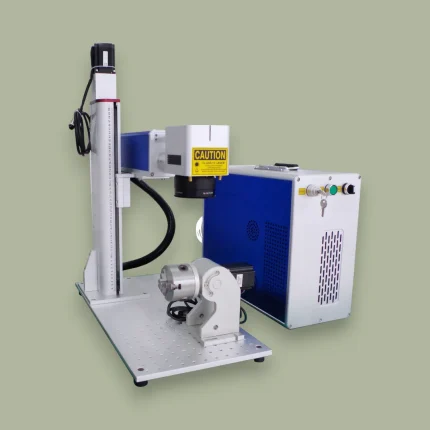
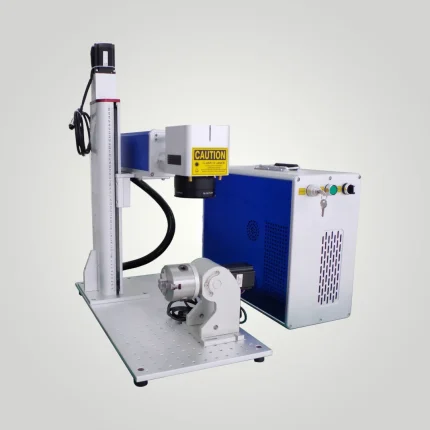
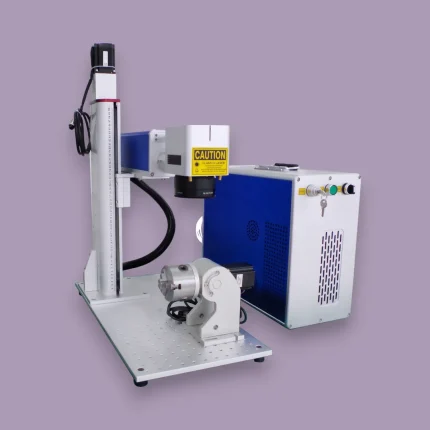
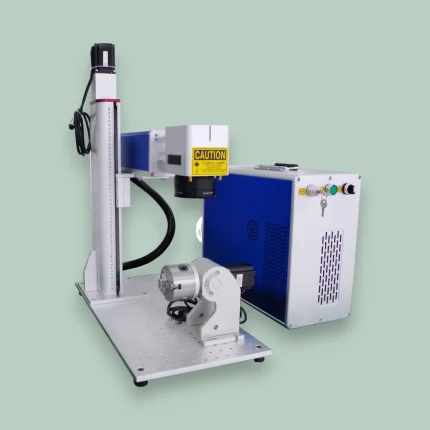
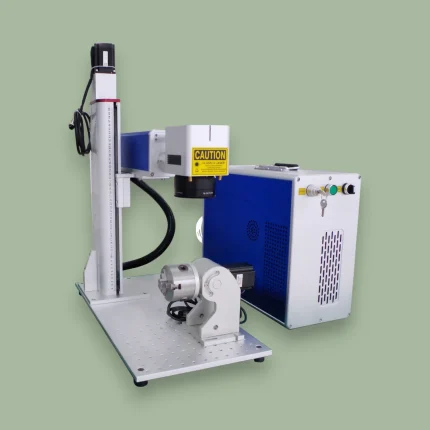
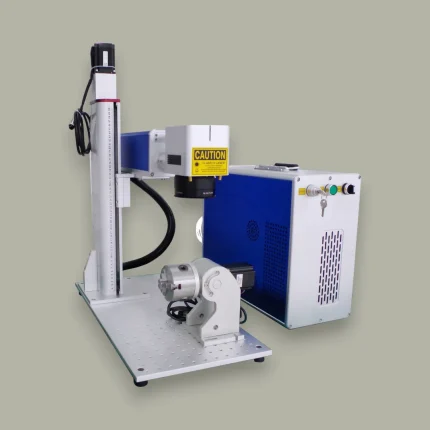
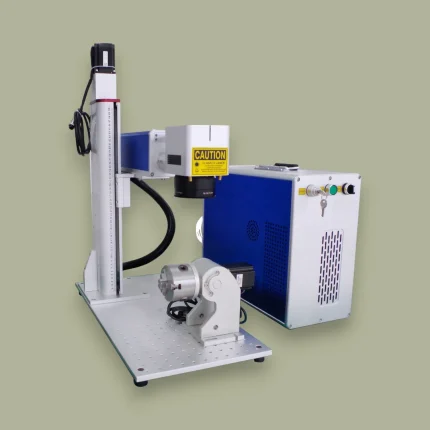
200W MOPA M7 Fiber Laser Machine
$9,500.00
Serious Material Removal. 200W MOPA power provides the necessary energy for extreme deep engraving and high-speed ablation. Ideal for tool and die work, heavy serialization, and fast laser cleaning. Double your speed and depth capacity now.
More views
Overview
The 200W MOPA M7 is the workhorse of our industrial fiber laser galvo line, built around an authentic JPT Opto-Electronics M7 source designated YDFLP-200-M7-M-R. At 200 watts of average power with MOPA pulse architecture, this is where most industrial production buyers settle when they need real depth, real throughput, and real source authenticity at a price that still fits an SMB capital plan. Pulse frequency stays adjustable from 1 to 4000 kHz and pulse width from 2 to 500 ns, so even at this tier you keep the MOPA control that opens up color marking on stainless and consistent line-rate output.
Production shops choose the 200W tier when 100W is the throughput bottleneck or when the work calls for deeper marks on harder metals. Industrial valve traceability is a canonical example: AVK, an industrial valve manufacturer, runs the 200W M7 for cast iron and steel valve body marking where the data matrix needs to survive outdoor service, paint coats, and decades of pipeline exposure. Other 200W workloads include heavy industrial component serialization, mold marking on tool steel, deep engraving on hardened parts, and thin metal cutting up to roughly 1 mm of stainless or 0.8 mm of brass and copper.
What you get from JPT Laser Shop specifically: a genuine JPT M7 source (the YDFLP-200-M7-M-R with traceable serial number, the no-prefix M variant), the Sino-Galvo SG7110 production-grade scanning head, DDP shipping that includes customs clearance and import duties for US, Canada, and EU buyers, and a 3-year warranty on both the M7 source and the machine. The source is air-cooled per the JPT specification, which keeps the machine simpler in the field than equivalent water-cooled designs.
Technical specifications
Specs are organized in three blocks: the JPT M7 laser source itself, the Sino-Galvo SG7110 scanner that drives the beam, and the complete machine assembly. The first two come straight from the published manufacturer datasheets; the third (complete machine) depends on the enclosure we build around those components.
Laser source, JPT YDFLP-200-M7-M-R
| Source model | JPT YDFLP-200-M7-M-R |
|---|---|
| Architecture | MOPA (Master Oscillator Power Amplifier), no-prefix M7 line |
| Average output power | > 200 W |
| Wavelength | 1064 nm |
| Pulse width range | 2 to 500 ns (adjustable) |
| Pulse frequency range | 1 to 4000 kHz |
| Maximum pulse energy | 1.5 mJ |
| Beam quality M² | < 1.6 |
| Output beam diameter | 7 ± 0.5 mm |
| Output power stability | < 5% |
| Emission bandwidth @3dB | < 20 nm |
| Polarization | Random |
| Anti-high reflection | Yes (handles back-reflection from copper, brass, polished alloys) |
| Cooling method | Air-cooled |
| Supply DC voltage | 48 V |
| Maximum power consumption | < 800 W |
| Environmental supply current | > 16 A |
| Operating temperature | 0 to 40 °C |
| Storage temperature | −10 to 60 °C |
| Source net weight | 24.8 kg |
| Source dimensions (L×W×H) | 430 × 351 × 133 mm |
| Armored cable length | 5 m |
Galvo scanner, Sino-Galvo SG7110
| Scanner model | Sino-Galvo SG7110 |
|---|---|
| Aperture | 10 mm |
| Scan angle | ± 11 degrees |
| Marking speed | up to 6000 mm/s |
| Positioning speed | up to 11000 mm/s |
| Repeat positioning accuracy | < 8 microradians |
| Working area (with included 175 mm lens) | 175 × 175 mm |
| Other working areas | varies with 70, 110, 210, or 300 mm lens choice |
Complete machine
| Power input | 110 to 240 V AC, 50/60 Hz (universal, region cable supplied at checkout) |
|---|---|
| Cooling | Air-cooled (no chiller required) |
| Software included | EZCad 2 and EZCad 3 on USB key |
| Software compatibility | EZCad 2, EZCad 3, LightBurn via adapter |
| Connectivity | USB, Ethernet, optional TCP/IP and I/O for production-line integration |
| Warranty | 3 years on JPT M7 source and machine |
What this machine can do
The 200W tier is where production volume work and depth-of-mark requirements meet. Five canonical applications:
Industrial valve and flange traceability
Cast iron and steel valve body marking with data matrix codes and serial numbers. AVK uses this machine for pipeline-grade valve traceability where the mark must survive paint, weather, and decades of outdoor service.
Deep engraving on hardened steel
Tool serialization, mold marking, fastener identification on hardened tool steel. The 200W M7 reaches 0.3 to 0.7 mm depth in a production-feasible cycle time for industrial volumes.
Thin metal cutting up to 1 mm
Stainless 0.5 to 1.0 mm, brass 0.3 to 0.8 mm, copper 0.2 to 0.6 mm, aluminum 0.3 to 0.8 mm. For thicker production cutting, look at CNC fiber cutters when launched.
Production line serial marking
Date codes, lot numbers, variable text, and vector logos on metal parts at line speed. The 200W duty cycle margin handles sustained production shifts comfortably.
Color marking on stainless steel
MOPA pulse modulation still delivers full-spectrum color marking at the 200W tier, though for boutique color jewelry work the 100W or 30W MOPA M7 with their tighter beam quality are the better fit.
How this compares to adjacent models
| Specification | 100W MOPA M7 | 120W MOPA M8 | ★ This machine 200W MOPA M7 |
350W MOPA M7 |
|---|---|---|---|---|
| Best for | Color marking + versatility | Glass drilling + finer-pulse work | Industrial production sweet spot | Top-tier production depth |
| Source model | YDFLP-100-M7-M-R | JPT M8 120W | YDFLP-200-M7-M-R | YDFLP-350-M7-M-R |
| Average power | > 100 W | > 120 W | > 200 W | > 350 W |
| Beam quality M² | < 1.4 | ~ 1.4 typical | < 1.6 | < 1.6 |
| Cooling | Air-cooled | Water-cooled | Air-cooled | Air-cooled |
| Thin metal cutting | up to 0.5 mm | up to 0.8 mm | up to 1.0 mm | up to 1.5 mm |
| Lead time | 2 to 3 weeks | 3 to 4 weeks | 2 to 3 weeks | 3 to 4 weeks |
| Warranty | 3 years | 3 years | 3 years | 3 years |
Practical guidance: choose the 200W over the 100W when production throughput is the bottleneck, when the work is on harder metals (hardened steel, cast iron, dense brass) where 100W gets thermal-limited, or when thin metal cutting above 0.5 mm is in scope. Choose the 200W over the 120W M8 unless you specifically need M8’s glass-drilling capability (M8 has shorter pulse minimum that helps with brittle materials, which the M7 architecture does not target). See the full fiber laser comparison →
What’s in the box
Same included-accessories package as every JPT Laser Shop galvo machine; no surprise add-ons at checkout.
- 2 quartz (fused-silica) field lenses of your choice from 70 mm, 110 mm, 175 mm, 210 mm, or 300 mm
- 1 rotary attachment of your choice: D60, D80, or D100 chuck
- Motorized Z-axis for focus on stepped parts
- Wavelength-matched laser safety glasses (1064 nm)
- Foot pedal for hands-free firing
- Marking head with your selected lens fitted
- USB and Ethernet cables
- Power cable for your region (US, EU, UK, AU plugs, specified at checkout)
- Software USB key with EZCad 2 and EZCad 3 licenses
- Quick-start guide (English by default; other languages on request)
- Cleaning kit and spare lens wipes
- 3-year warranty registration card
Optional upgrades available at checkout: 2.5D EZCad 3 Z-control unlock (USD 750) for software-driven depth variation during a marking job, and the Feeltek dynamic-focus 3D head (USD 5,500) for true 3D contoured marking on non-planar workpieces.
Software and upgrade options
This machine ships with the standard Sino-Galvo SG7110 galvo head and EZCad 2 software included on USB. Two optional factory upgrades extend what the machine can do; either can be configured at the time of order.
Base configuration: SG7110 head + EZCad 2 + LightBurn via adapter
The standard configuration covers all flat-surface 2D marking applications. EZCad 2 is the most widely used fiber laser control software in production environments, with full support for variable text, serialized marking, photo engraving, vector imports, and TCP/IP and I/O integration for production lines. LightBurn is supported via a USB adapter that ships with the machine for operators who prefer that workflow.
2.5D upgrade: BJJCZ G3 Pro head + EZCad 3 (USD 750)
This upgrade replaces the SG7110 with the BJJCZ G3 Pro head and adds EZCad 3 software (included). What you gain: stepped Z-axis control during a single design pass. The laser can mark at two or three different focal heights on the same workpiece without manually re-cranking the Z between layers. Right for stepped workpieces, terraced parts, deep-engraving multi-pass jobs, and any application where distinct height layers need to be marked in one sequence.
Full 3D upgrade: Feeltek FR10-F dynamic-focus head + LenMark (USD 5,500)
The FR10-F steers focus in software (LenMark) and uses no swappable field lens — it is offered in 100 × 100 mm and 200 × 200 mm field sizes.
This upgrade replaces the SG7110 with the Feeltek FR10-F 3D dynamic-focus head and adds LenMark software (Feeltek’s controller-side 3D mapping and design-wrap software). What you gain: continuous focal-length adjustment as the galvo mirrors point the beam across a curved or three-dimensional workpiece. The beam stays at true focus across the full surface in real time, not just one calibrated band.
When to choose the 3D upgrade: production volume on curved workpieces. If you are running dozens to thousands of curved parts per shift (rounded glass bottles, watch case-backs, ceramic vials, headphone shells, lampshades, contoured metal parts), the 3D head pays back through faster cycle time and consistent edge-to-edge focus quality. For one-off curved jobs the standard fixed-focus head with manual Z repositioning still works, but the cycle time per piece is significantly longer. The math typically points to the 3D upgrade once you commit to a recurring production run on curved parts.
Our 3D engraving guide walks through the complete Feeltek-plus-LenMark workflow from CAD model to engraved curved part. The guide is written for UV but the CAD-to-LenMark process is identical on fiber.
Marking area by lens
The included lens choice determines the marking area on the workpiece. Every JPT machine ships with two lenses of your choice from the standard set; the 175 mm lens is included by default unless you specify otherwise at checkout.
| Lens focal length | Marking area | Best for |
|---|---|---|
| 70 mm | 70 x 70 mm | Small jewelry, watch components, fine detail at maximum resolution |
| 110 mm | 110 x 110 mm | Medium parts: dog tags, challenge coins, small electronic enclosures |
| 175 mm (default) | 175 x 175 mm | General production: tumblers, plates, mid-size parts, the most common pick |
| 210 mm | 210 x 210 mm | Larger flat parts: serving trays, panels, batch marking |
| 300 mm | 300 x 300 mm | Maximum area: large panels, batch grids, low-detail full-field engraving |
Shorter focal lengths give finer beam spots and higher detail resolution at the cost of a smaller marking area. Longer focal lengths cover more area at the cost of slightly softer detail. Most production shops run two lenses (one shorter, one longer) to cover the working range without swapping mid-job.
Configuration and capability summary
| Configuration | Head | Software | Use case |
|---|---|---|---|
| Base (standard) | Sino-Galvo SG7110 | EZCad 2 (USB), LightBurn (via adapter) | Flat-surface 2D marking |
| 2.5D upgrade (USD 750) | BJJCZ G3 Pro | EZCad 3 (USB) | Stepped or terraced workpieces, multi-height marking |
| 3D upgrade (USD 5,500) | Feeltek FR10-F dynamic-focus | LenMark (Feeltek) | Curved 3D workpieces in production volume |
Both upgrades are installed at the factory at the time of order. Adding either later requires shipping the machine back as a service exchange, which is doable but takes longer than ordering with the upgrade up front. If you know at purchase that you will be marking stepped or curved workpieces in volume, configure the upgrade at checkout.
Shipping and delivery
Lead time: 2 to 3 weeks from order confirmation. Every machine is calibrated and tested before crating.
Shipping: The 200W ships DDP at no extra cost to US, Canadian, and EU 27 buyers. DDP means “Delivered Duty Paid”, which is the Incoterm where the seller (us) absorbs ocean freight, ground freight, customs brokerage, and all duties through your country’s border authority. Crate plus machine weighs in around 50 to 55 kg, which is mid-pack for our galvo line. DDP transit is approximately 30 days by sea freight to US and Canada or 20 days by rail freight to EU 27, with customs and import duties included in the price. CIF air freight is available worldwide at 12 to 15 days transit if you prefer faster delivery and handle customs clearance yourself. For destinations outside the DDP zones, freight is free but import duties and customs clearance are handled on your end.
Freight delivery: curbside is the default; lift-gate available at the time of dispatch on request. Most production buyers at the 200W tier have receiving docks, so curbside works. Real-time tracking from factory release through final delivery. The full freight contract terms are on the shipping policy page if you need them for procurement records.
Warranty
The 200W MOPA M7 includes a 3-year warranty on both the JPT M7 source and the machine, the highest tier in our warranty matrix, applied to all no-prefix M7 and M8 fiber galvo machines. The warranty covers manufacturer defects, source failure not caused by misuse, and the machine’s control electronics and assembly. Software updates are free for the lifetime of the machine.
Return terms: 30-day window from delivery for confirmed manufacturing defects only. Our engineering team handles the technical confirmation; once a defect is confirmed, we cover return freight in the original crate. The defect-only policy applies because every 200W is built to order at the JPT factory and the inventory cannot be redeployed after a return. Full policy text and the engineering confirmation process are on the returns and warranty page.
Frequently asked questions
Why the 200W over the 100W?
Throughput and depth. The 200W doubles the average power, which translates into roughly 30 to 50% faster cycle times on production deep marking, plus the headroom to engrave hardened tool steel and cast iron where 100W gets thermal-limited. For color marking on stainless and color-spectrum jewelry work, the 100W’s tighter beam quality (M² less than 1.4 versus less than 1.6 on the 200W) is the better fit.
Is the 200W really still air-cooled?
Yes. JPT specifies the YDFLP-200-M7-M-R as air-cooled, and no external chiller is required. Ambient temperature should stay within 0 to 40 degrees Celsius, which covers any normal production environment. The 200W only requires water cooling if you switch to the M8 architecture variant (a different SKU we do not currently stock).
How much electricity does this draw?
Maximum power consumption is under 800 W at 48 V DC. At a typical 8-hour shift, 250 working days per year, and US average electricity at $0.15 per kWh, that works out to roughly $240 per year in electricity for the laser source itself. The 200W consumes about double the 100W tier but stays well below the 350W tier.
What thickness of metal can it cut?
In practical production: stainless steel 0.5 to 1.0 mm, brass 0.3 to 0.8 mm, copper 0.2 to 0.6 mm, aluminum 0.3 to 0.8 mm. The galvo geometry caps the realistic cutting envelope. For production sheet metal cutting above 1.5 to 2 mm you want a CNC fiber laser cutter.
Will this do color marking on stainless steel?
Yes, full-spectrum color marking is supported because the MOPA architecture controls pulse width and frequency at this tier. For boutique color jewelry or watch components where hue consistency batch-to-batch is critical, the 100W or 30W MOPA M7 is the better choice (tighter beam quality M² less than 1.4).
Which JPT M7 variant is this?
The no-prefix M variant, model YDFLP-200-M7-M-R per the JPT Opto-Electronics product code, with traceable serial numbers. We are an authorized JPT distributor; the authorization documentation is on our authorized distributor page.
What is the lead time from order to delivery?
Roughly 5 to 7 weeks total. The 200W M7 source has stable factory turnover at JPT, so production runs 2 to 3 weeks. DDP transit is approximately 30 days by sea freight to US and Canada or 20 days by rail freight to EU 27, with customs and import duties included in the price. CIF air freight is available worldwide at 12 to 15 days transit if you prefer faster delivery and handle customs clearance yourself. The 200W tier has one of the more predictable lead times in our catalog because the source production volume is high.
Are import duties really included in the listed price?
Yes, for US, Canada, and EU 27 shipments. DDP is our default Incoterm, which means our quoted price covers freight plus customs clearance plus all duties and tariffs at entry into your country. We do US Customs and Border Protection clearance, Canadian Border Services Agency, or the relevant EU member state customs authority directly. For rest-of-world buyers: shipping is free but customs handling at the destination port is on you or your customs broker.
Does the warranty really cover the source too?
Yes. The 3-year warranty applies to both the JPT M7 source and the machine assembly. The JPT M7 source is rated for 100,000 hours of continuous operation; the warranty covers manufacturer defects and source failure not caused by misuse.
Customer outcomes
AVK, an industrial valve manufacturer, runs the 200W M7 for cast iron and steel valve body traceability. The data matrix codes survive paint, weather, and decades of pipeline service. Full case study coming soon.
AVK, customer reference on file with written permission
You may also consider
| Color | Black |
|---|
1 review for 200W MOPA M7 Fiber Laser Machine
What it can mark
Sample marks shown are representative of this machine class. Ask an engineer for a free test mark on your own material.
Related products


Brian Sims –
I personally have had 4 different systems from JPT including the 200W M7 and I have never had any issues. There are never any hidden costs or tariff issues, nor warranty issues. Their marking equipment is top quality.