
- You must select exactly 2 choices for Lens size.
- "Lens size" is a required field.
- "Rotary" is a required field.

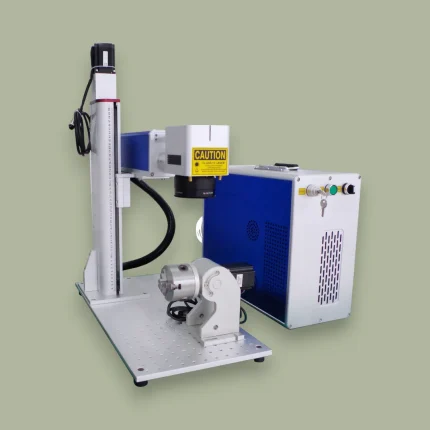
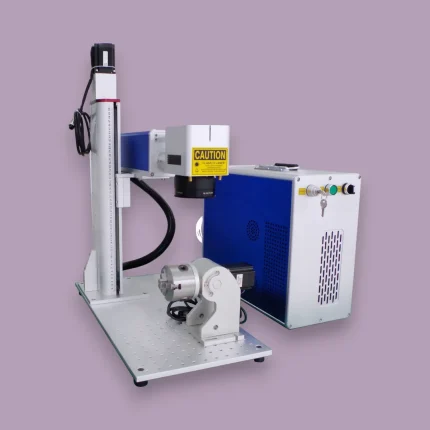
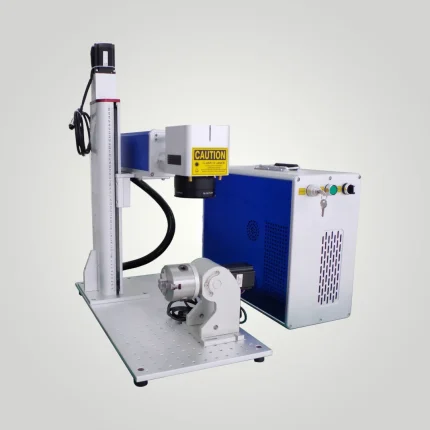
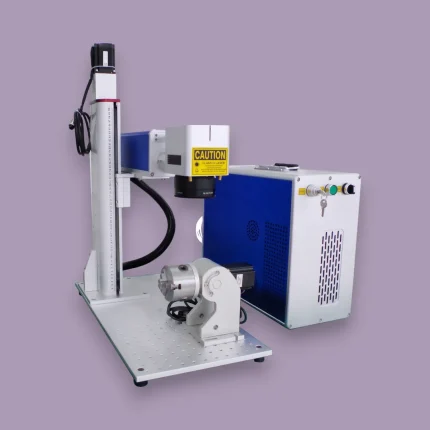
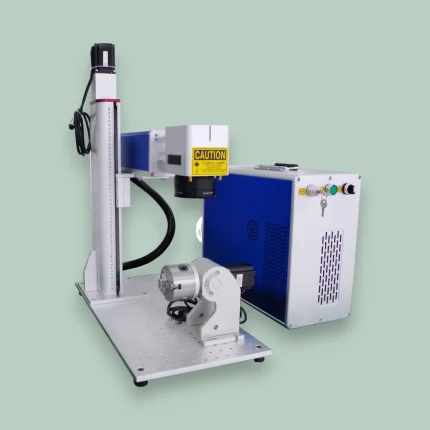
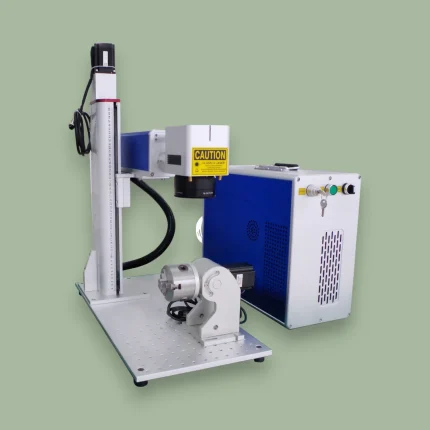
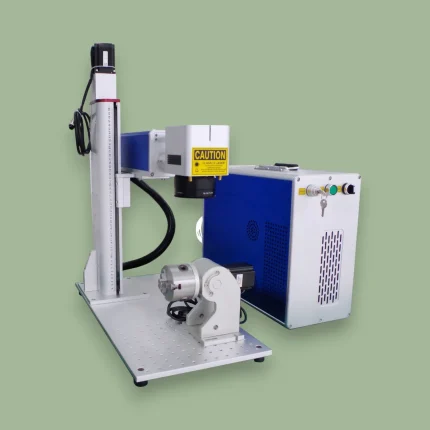
120W M8 MOPA Fiber Laser Machine
$10,500.00
Unrivaled M8 JPT Power. Maximize your industrial throughput with 120W for ultra-fast deep relief and production-grade metal cutting. The ultimate MOPA for 3D carving and large-field consistency. Power up your profitability.
More views
Overview
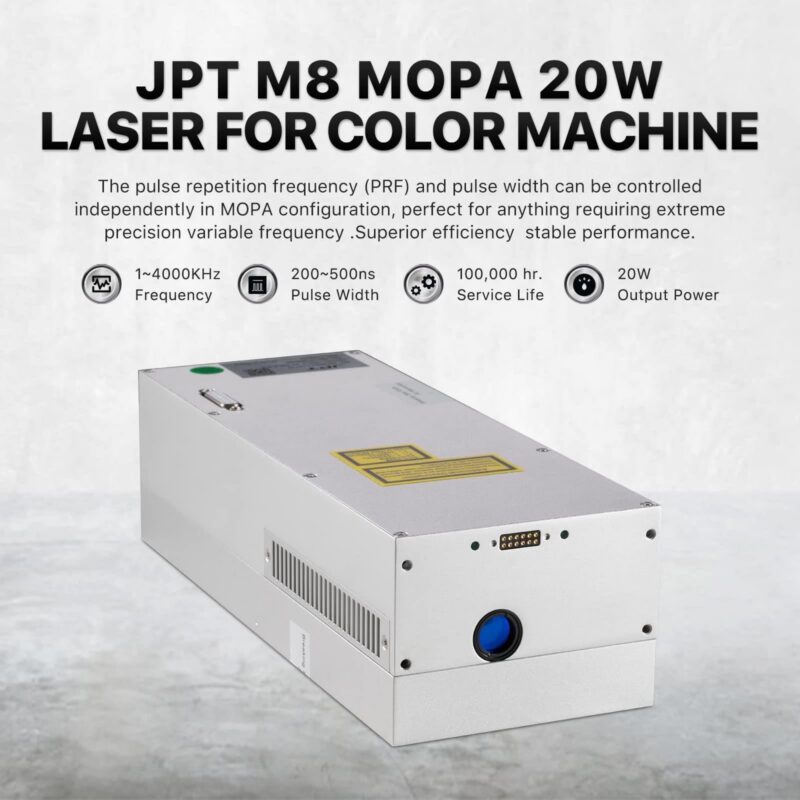
The 120W M8 is JPT’s higher-end MOPA architecture at the 120-watt power tier. M8 differs from M7 in two ways that matter: the pulse width range is shifted shorter (typically 6 to 100 ns versus M7’s 2 to 500 ns), and the source uses water-cooling rather than air-cooling. The short-pulse capability is the practical reason most buyers choose M8 over M7: shorter pulses produce higher peak power per nanosecond, which unlocks glass drilling, brittle material processing, and the kind of micromachining that M7 cannot do cleanly.
Production buyers at this tier are typically doing work where M7 ran into a material limitation. Glass drilling and marking (perfume bottles, lab glassware, micro-holes) is the canonical example: JPT lists glass drilling as a 120W-and-up M8 capability, and the short pulse minimizes the bead-edge thermal damage that would otherwise crack glass. Other M8 workloads include precision marking on alumina ceramic, lithium battery foil cutting, semiconductor wafer scribing in small lots, and dense metal microengraving where the wider M7 pulse leaves a heat-affected zone too wide for the application tolerance.
What you get from JPT Laser Shop: a genuine JPT M8 architecture source, the Sino-Galvo SG7110 production-grade scanning head, DDP shipping with customs and import duties included for US, Canada, and EU buyers, and a 3-year warranty on both the M8 source and the machine. The M8 source ships water-cooled by JPT spec, which means an integrated chiller is part of the machine (no external chiller to plumb). The package is heavier and slightly more complex than M7 air-cooled machines, but the short-pulse capability is what justifies the step.
Technical specifications
The 120W M8 specifications below are based on JPT’s published M8 architecture documentation. The 100W M8 datasheet (YDFLP-100-M8-M-R) is the closest verified reference in our spec library; the 120W tier shares the same M8 architecture with proportionally higher average power. Exact 120W M8 datasheet entries marked pending below are confirmed against the JPT source ID plate on every shipped machine.
Laser source, JPT M8 120W
| Source family | JPT YDFLP M8 series (exact 120W M8 model code on source ID plate per shipment) |
|---|---|
| Architecture | MOPA (Master Oscillator Power Amplifier), M8 series |
| Average output power | > 120 W |
| Wavelength | 1064 nm |
| Pulse width range | Typically 6 to 100 ns (M8 architecture; narrower than M7) |
| Pulse frequency range | Wide range, M8 architecture (exact 120W tier values per shipped datasheet) |
| Beam quality M² | ~ 1.4 (typical for M8 architecture) |
| Polarization | Random |
| Anti-high reflection | Yes |
| Cooling method | Water-cooled (integrated chiller, no external plumbing required) |
| Supply DC voltage | 48 V |
| Operating temperature | 0 to 40 °C |
Note on transparency: the 100W M8 (YDFLP-100-M8-M-R) datasheet specifies max pulse energy 0.58 mJ at 12 ns, water cooling, and a 10.2 kg source weight at 450 by 235 by 70 mm. The 120W M8 source is a closely related variant. We do not publish exact 120W spec numbers in this table because the specific 120W M8 datasheet is not in our publication library yet. If exact 120W M8 specs are critical for your application engineering, email us and we can request the exact 120W M8 datasheet from JPT.
Galvo scanner, Sino-Galvo SG7110
| Scanner model | Sino-Galvo SG7110 |
|---|---|
| Aperture | 10 mm |
| Scan angle | ± 11 degrees |
| Marking speed | up to 6000 mm/s |
| Positioning speed | up to 11000 mm/s |
| Repeat positioning accuracy | < 8 microradians |
| Working area (with included 175 mm lens) | 175 × 175 mm |
| Other working areas | varies with 70, 110, 210, or 300 mm lens choice |
Complete machine
| Power input | 110 to 240 V AC, 50/60 Hz (universal, region cable supplied at checkout) |
|---|---|
| Cooling | Water-cooled, integrated chiller (no external plumbing required) |
| Software included | EZCad 2 and EZCad 3 on USB key |
| Software compatibility | EZCad 2, EZCad 3, LightBurn via adapter |
| Connectivity | USB, Ethernet, optional TCP/IP and I/O |
| Warranty | 3 years on JPT M8 source and machine |
What this machine can do
The 120W M8 is built for work where M7 hit a material limitation. Five canonical applications:
Glass drilling and marking
Perfume bottles, wine bottles, lab glassware, awards, and micro-hole through-drilling. M8’s short pulse minimizes the heat-affected zone that causes M7 to crack glass at the bead edge.
Precision marking on ceramic and alumina
Electronics substrates, medical device ceramic components, and brittle materials where M7 thermal influence cracks the surface. M8 short-pulse minimizes the affected zone.
Battery foil cutting and thin-film processing
Lithium battery foil cutting (electrode patterning), thin metal film processing, and similar precision work where the cut needs to be clean and the heat-affected zone needs to be minimal.
Semiconductor wafer scribing (small lots)
Silicon wafer scribing and similar microprocessing for prototype and small-lot production. M8 is the entry point into semiconductor-grade laser processing without stepping up to picosecond or femtosecond lasers.
Precision metal microengraving
Dense data matrix codes on small parts, micro-text on hardened tool steel, fine-feature engraving where M7’s wider beam and longer pulse leaves a heat-affected zone too wide for the application tolerance.
What 120W M8 is not for: budget jewelry color marking (M7 100W is the better value), high-volume production color marking (M7 100W or 200W is faster and cheaper), heavy industrial deep engraving on steel (M7 200W or 350W has the right pulse profile for ablation depth), thin metal cutting above 1 mm (M7 200W or 350W is more cost-effective).
How this compares to adjacent models
| Specification | 100W MOPA M7 | 120W MOPA M7 | ★ This machine 120W M8 |
200W MOPA M7 |
|---|---|---|---|---|
| Best for | Color marking + versatility | Same as 100W + deeper | Glass drilling, brittle materials, microengraving | Industrial production sweet spot |
| Architecture | No-prefix M7 MOPA | No-prefix M7 MOPA | M8 MOPA (short-pulse) | No-prefix M7 MOPA |
| Pulse width | 2 to 500 ns | 2 to 500 ns | 6 to 100 ns (typ) | 2 to 500 ns |
| Cooling | Air-cooled | Air-cooled | Water-cooled (integrated) | Air-cooled |
| Glass + brittle materials | Marginal | Marginal | Yes (key M8 use case) | Marginal |
| Color marking on stainless | Excellent | Excellent | Yes (not the primary fit) | Good |
| Deep metal engraving | Good | Better | Marginal (short pulse limits depth) | Excellent |
| Warranty | 3 years | 3 years | 3 years | 3 years |
Practical guidance: the M8 is the right tier when your work specifically needs short-pulse architecture (glass, ceramic, thin film, micro-feature work). For everything else, M7 at the appropriate power tier is the better value because of the simpler air-cooled chassis and the wider pulse range that handles both shallow precision marking and deep ablation in the same machine. Do not buy the 120W M8 just to “step up from 100W M7”; that step is the wrong direction unless the new material is glass or ceramic. See the full fiber laser comparison →
What’s in the box
Same included-accessories package as every JPT Laser Shop galvo machine.
- 2 quartz (fused-silica) field lenses of your choice from 70 mm, 110 mm, 175 mm, 210 mm, or 300 mm
- 1 rotary attachment of your choice: D60, D80, or D100 chuck
- Motorized Z-axis for focus on stepped parts
- Wavelength-matched laser safety glasses (1064 nm)
- Foot pedal for hands-free firing
- Integrated water chiller (no external plumbing required for the M8 cooling loop)
- Marking head with your selected lens fitted
- USB and Ethernet cables
- Power cable for your region (US, EU, UK, AU plugs, specified at checkout)
- Software USB key with EZCad 2 and EZCad 3 licenses
- Quick-start guide and cooling-loop maintenance instructions
- Cleaning kit and spare lens wipes
- 3-year warranty registration card
Optional upgrades available at checkout: 2.5D EZCad 3 Z-control unlock (USD 750), and the Feeltek dynamic-focus 3D head (USD 5,500) for 3D contoured marking.
Software and upgrade options
This machine ships with the standard Sino-Galvo SG7110 galvo head and EZCad 2 software included on USB. Two optional factory upgrades extend what the machine can do; either can be configured at the time of order.
Base configuration: SG7110 head + EZCad 2 + LightBurn via adapter
The standard configuration covers all flat-surface 2D marking applications. EZCad 2 is the most widely used fiber laser control software in production environments, with full support for variable text, serialized marking, photo engraving, vector imports, and TCP/IP and I/O integration for production lines. LightBurn is supported via a USB adapter that ships with the machine for operators who prefer that workflow.
2.5D upgrade: BJJCZ G3 Pro head + EZCad 3 (USD 750)
This upgrade replaces the SG7110 with the BJJCZ G3 Pro head and adds EZCad 3 software (included). What you gain: stepped Z-axis control during a single design pass. The laser can mark at two or three different focal heights on the same workpiece without manually re-cranking the Z between layers. Right for stepped workpieces, terraced parts, deep-engraving multi-pass jobs, and any application where distinct height layers need to be marked in one sequence.
Full 3D upgrade: Feeltek FR10-F dynamic-focus head + LenMark (USD 5,500)
The FR10-F steers focus in software (LenMark) and uses no swappable field lens — it is offered in 100 × 100 mm and 200 × 200 mm field sizes.
This upgrade replaces the SG7110 with the Feeltek FR10-F 3D dynamic-focus head and adds LenMark software (Feeltek’s controller-side 3D mapping and design-wrap software). What you gain: continuous focal-length adjustment as the galvo mirrors point the beam across a curved or three-dimensional workpiece. The beam stays at true focus across the full surface in real time, not just one calibrated band.
When to choose the 3D upgrade: production volume on curved workpieces. If you are running dozens to thousands of curved parts per shift (rounded glass bottles, watch case-backs, ceramic vials, headphone shells, lampshades, contoured metal parts), the 3D head pays back through faster cycle time and consistent edge-to-edge focus quality. For one-off curved jobs the standard fixed-focus head with manual Z repositioning still works, but the cycle time per piece is significantly longer. The math typically points to the 3D upgrade once you commit to a recurring production run on curved parts.
Our 3D engraving guide walks through the complete Feeltek-plus-LenMark workflow from CAD model to engraved curved part. The guide is written for UV but the CAD-to-LenMark process is identical on fiber.
Marking area by lens
The included lens choice determines the marking area on the workpiece. Every JPT machine ships with two lenses of your choice from the standard set; the 175 mm lens is included by default unless you specify otherwise at checkout.
| Lens focal length | Marking area | Best for |
|---|---|---|
| 70 mm | 70 x 70 mm | Small jewelry, watch components, fine detail at maximum resolution |
| 110 mm | 110 x 110 mm | Medium parts: dog tags, challenge coins, small electronic enclosures |
| 175 mm (default) | 175 x 175 mm | General production: tumblers, plates, mid-size parts, the most common pick |
| 210 mm | 210 x 210 mm | Larger flat parts: serving trays, panels, batch marking |
| 300 mm | 300 x 300 mm | Maximum area: large panels, batch grids, low-detail full-field engraving |
Shorter focal lengths give finer beam spots and higher detail resolution at the cost of a smaller marking area. Longer focal lengths cover more area at the cost of slightly softer detail. Most production shops run two lenses (one shorter, one longer) to cover the working range without swapping mid-job.
Configuration and capability summary
| Configuration | Head | Software | Use case |
|---|---|---|---|
| Base (standard) | Sino-Galvo SG7110 | EZCad 2 (USB), LightBurn (via adapter) | Flat-surface 2D marking |
| 2.5D upgrade (USD 750) | BJJCZ G3 Pro | EZCad 3 (USB) | Stepped or terraced workpieces, multi-height marking |
| 3D upgrade (USD 5,500) | Feeltek FR10-F dynamic-focus | LenMark (Feeltek) | Curved 3D workpieces in production volume |
Both upgrades are installed at the factory at the time of order. Adding either later requires shipping the machine back as a service exchange, which is doable but takes longer than ordering with the upgrade up front. If you know at purchase that you will be marking stepped or curved workpieces in volume, configure the upgrade at checkout.
Shipping and delivery
Lead time: 3 to 4 weeks from order confirmation. The M8 source has a longer JPT factory lead time than M7 because production volume of M8 sources is lower; every machine is calibrated and tested before crating.
Shipping: The 120W M8 ships DDP to US, Canada, and the EU 27; DDP covers freight, customs clearance, and all duties for those zones. The M8 chassis is heavier than equivalent-power M7 tiers because the integrated water-cooling chiller is built into the machine (no external chiller to ship separately). Total shipping weight runs around 55 to 65 kg.DDP transit is approximately 30 days by sea freight to US and Canada or 20 days by rail freight to EU 27, with customs and import duties included in the price. CIF air freight is available worldwide at 12 to 15 days transit if you prefer faster delivery and handle customs clearance yourself. Outside DDP zones: free shipping, customs is on you.
Delivery: curbside is standard, lift-gate available on request. The integrated chiller adds weight versus M7 air-cooled equivalents, so lift-gate delivery is the safer choice for receiving facilities without a loading dock. Tracking from factory dispatch through final delivery. Detailed freight contract terms on the shipping policy page.
Warranty
The 120W M8 includes a 3-year warranty on both the JPT M8 source and the machine, the highest tier in our warranty matrix, applied to all no-prefix M7 and M8 fiber galvo machines. The warranty covers manufacturer defects, source failure not caused by misuse, the integrated chiller, and the machine’s control electronics.
Return terms: 30-day window from delivery for confirmed defects only; engineering team handles technical confirmation including the integrated chiller and cooling-loop diagnostics. We cover return freight in the original crate when a defect is confirmed. The defect-only policy applies because every M8 is built to order at the JPT factory and shipped DDP. Documentation: returns and warranty page.
Frequently asked questions
What is the difference between M7 and M8?
Pulse architecture. M7 has wide pulse range (2 to 500 ns) and air cooling at all power tiers we sell. M8 has shorter pulse range (typically 6 to 100 ns) and water cooling. The short pulse is the M8 advantage: higher peak power per nanosecond means cleaner work on glass, ceramic, and brittle materials. M7 is better for most metal marking and ablation because the longer pulse range gives more thermal control.
Can the 120W M8 do color marking?
Yes, M8 supports color marking on stainless steel, but it is not the primary M8 use case. If color marking is your main work, the 100W or 30W MOPA M7 is the better choice (tighter beam, wider pulse range for color tuning, no chiller maintenance, lower price). Buy M8 specifically for glass, ceramic, or microengraving work.
Does the integrated chiller need maintenance?
Yes. The cooling loop uses distilled water (or de-ionized water in regions with hard tap water). The chiller filter and reservoir need inspection roughly every 6 to 12 months depending on duty cycle. Standard maintenance is documented in the quick-start guide we ship with the machine.
Is glass drilling practical at 120W M8?
Yes. JPT lists glass drilling as a capability of the 120W and higher M8 tiers, so the 120W M8 drills sub-millimeter holes in glass and marks it, while the 20W and 50W M8 do glass marking only. Deep through-drilling in thick glass (above 5 mm) is more demanding and benefits from the 200W or 300W M8 and parameter tuning per glass type. The 120W M8 does both glass marking and drilling; the 200W and 300W M8 add throughput for industrial-scale drilling and cutting.
Why is the 120W M8 lead time longer than M7?
M8 sources are produced in lower volumes at the JPT factory than M7. Our standard 120W M8 lead time is 3 to 4 weeks versus 2 to 3 weeks for equivalent M7 power tiers. If your delivery window is tight, M7 at the appropriate power tier is the faster path; only choose M8 when the application specifically requires short-pulse architecture.
How long does delivery take for an M8 order?
Budget 6 to 8 weeks total. M8 sources have lower production volume at the JPT factory than M7 (specialty product line), so factory build runs 3 to 4 weeks. After factory dispatch, DDP transit is approximately 30 days by sea freight to US and Canada or 20 days by rail freight to EU 27, with customs and import duties included in the price. CIF air freight is available worldwide at 12 to 15 days transit if you prefer faster delivery and handle customs clearance yourself. If your timeline is tight, mention it early; we can sometimes flag M8 orders for priority at JPT.
Are customs fees included in the price for international buyers?
For US, Canada, and EU 27 buyers, yes; DDP shipping covers freight, customs clearance, and all duties at entry. The integrated chiller on the M8 makes the crate slightly heavier than M7 air-cooled equivalents, but the DDP model means you don’t see that as a separate line item; the listed price is what you pay. Outside DDP zones: free shipping, customs and import handling is the buyer’s responsibility at destination.
What is the exact 120W M8 model code?
The 120W M8 source is the JPT YDFLP-x-M8-M-R series. The exact 120W M8 datasheet is not in our public publication library yet; the JPT model code on the source ID plate is verified per shipment, and the architecture characteristics (water-cooled, short pulse) match the M8 family. If you need the exact 120W M8 datasheet before ordering, email us and we can request it from JPT directly.
Production deployment notes
The 120W M8 is a specialty tier. Most M8 buyers are doing one specific job (glass marking, ceramic micromachining, battery foil cutting) and choose M8 because M7 cannot do that job cleanly. The typical M8 buyer profile is a contract manufacturer adding a niche capability, a research lab equipping a new process, or a prototyping shop serving electronics or biomedical clients. We do not publish a specific named customer reference for the 120W M8 tier yet. If you want to talk to a current M8 operator about workflow or material parameters before ordering, email us and we can coordinate a reference call where the existing customer has given permission.
You may also consider
| Color | White |
|---|
3 reviews for 120W M8 MOPA Fiber Laser Machine
What it can mark
Sample marks shown are representative of this machine class. Ask an engineer for a free test mark on your own material.
Related products



Russell L Lawhorn –
JPT Laser is the absolute best. I wouldn’t buy my 120W M8 from anyone else. Keep up the great work.
Isaac Kostuch –
Best in the marking business. Highly recommend the 120W M8 from JPT.
Oleg Luhovyi –
After 10 years of working with different suppliers, I can honestly say that JPT is one of the best I’ve dealt with. Every company will have technical glitches from time to time – that’s reality. The most important thing is how the support team handles those situations. Equipment can fail, but JPT scores 10/10 when it comes to taking responsibility for their customers and fixing my 120W M8. The quality is exceptional.